
A school principal in Gurugram showed us her borewell last year. The water level had dropped again, and the tanker bills had doubled. Meanwhile, her new parking shade stood in the monsoon and sent thousands of litres of clean rainwater straight into the drain.
“It’s such a waste,” she said. “Can the roof save it?”
It can. Tensile roof rainwater harvesting works better than most people expect, because fabric makes a smooth, clean catchment. Here’s how it works, what you can use the water for, and where owners go wrong.
Quick answer: A tensile roof sheds rain quickly into gutters, which carry it through pipes into a storage tank or a recharge pit. A typical 10,000 square foot roof can collect around 4.8 lakh litres in a year of normal Delhi NCR rainfall. Use the water for gardening, washing, and flushing, or send it underground to recharge groundwater. Don’t drink it unless you treat and test it. Plan the gutters and pipes at the design stage.
Why Is a Fabric Roof Good for Collecting Rain?
Fabric is smooth and sloped. Water doesn’t pause on it, so it runs off fast and takes less dust with it than a rough concrete terrace does. Coated membranes like PVDF and PTFE shed dirt especially well, so the water starts cleaner.
Tensile roofs also cover big areas. A parking shade, a walkway, or a school canopy often spreads over thousands of square feet. That’s a lot of free catchment that would otherwise go to waste.
And since the roof has a fixed shape, water follows predictable paths. Engineers can place gutters and downpipes exactly where the water collects.
How Much Water Can You Collect?
The maths is simple. One millimetre of rain on one square metre gives one litre. Then you lose a little, because some water splashes, evaporates, or overflows. Designers usually count on about 80 per cent of what falls.
Take a 10,000 square foot roof, which is about 930 square metres. Delhi NCR gets roughly 650 mm of rain in a normal year, though it varies a lot. So 930 × 650 × 0.8 gives about 4.8 lakh litres. That’s a rough yearly figure, not a promise.
Most of that falls in a few monsoon weeks. So your tank or pit has to be sized for heavy bursts, not for a gentle year-round drizzle.
What Does the System Include?
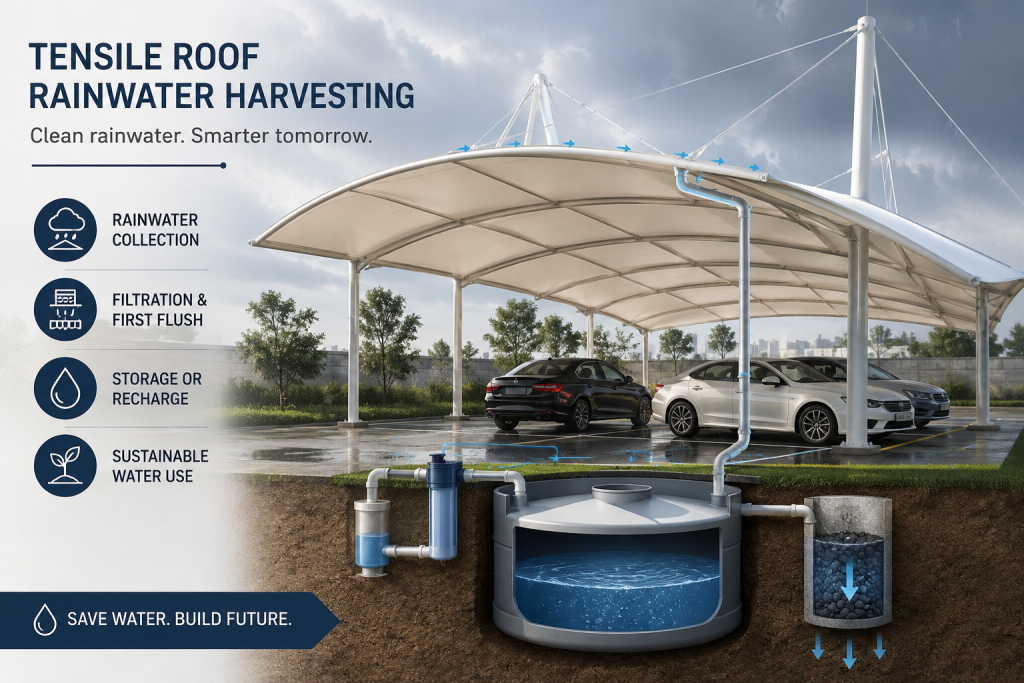
A basic setup has five parts.
Gutters. They run along the low edges of the fabric and catch the runoff. On a tensile roof, these edges are designed and fabricated with the structure, so ask for them in the original drawing.
Downpipes. They carry water from the gutters to the ground. Many designers hide them inside the steel columns for a clean look.
First-flush diverter. The first rain washes off dust, bird droppings, and pollution. A diverter throws away that first dirty flow and lets the cleaner water through.
Filter. A simple mesh or sand filter removes leaves and silt before the water reaches storage.
Storage or recharge. Either a tank holds the water for use, or a recharge pit sends it down into the ground. Many sites do both.
What Can You Use the Water For?
Treated or filtered rainwater suits non-drinking uses. Watering lawns and plants, washing vehicles and floors, cleaning the fabric itself, and flushing toilets all work fine.
For drinking, you’d need proper treatment and regular testing. Don’t skip that step. Roof water picks up dust, bird droppings, and air pollution on the way down.
Groundwater recharge is the other big option. Groundwater has been falling in many parts of NCR, and a recharge pit puts rainwater back where it belongs. Many local authorities also ask for rainwater harvesting on larger plots, so check the rules for your area.
What Mistakes Should You Avoid?
Skipping the plan is the first one. Adding gutters after the roof is up usually means ugly pipes and weak joints. Include them in the design.
Undersizing the pipes is the second. A monsoon burst can dump a huge flow in minutes. Small pipes overflow, and water ends up on your floor.
Ignoring maintenance is the third. Clean the gutters and filters before each monsoon. Leaves and dust block the flow, and a clogged gutter can hold water against the fabric edge.
What Does It Cost?
It depends on the roof size, the tank, and whether you add a recharge pit. A simple system, with gutters, pipes, a filter, and a small tank, adds a modest amount to your project. A large storage tank and a pump cost more. Ask for the harvesting system as its own line in your quote. You can see the structures we build on our Our Products page.
Frequently Asked Questions
Can you collect rainwater from a tensile roof?
Yes. The smooth, sloped fabric sheds water quickly into gutters and downpipes. Plan the drainage during the design stage.
Is the collected water safe to drink?
Not without proper treatment and testing. Use it for gardening, washing, and flushing, or send it to a recharge pit.
How much water can a roof collect?
Roughly one litre per square metre for every millimetre of rain, minus some losses. A 10,000 square foot roof can collect around 4.8 lakh litres in a normal Delhi NCR year.
Final Thought
A roof that catches the monsoon pays you back twice. It shades people today, and it saves water for tomorrow. Plan the gutters and downpipes with your fabricator, add a first-flush diverter, and decide early whether the water goes to a tank, a pit, or both. For help planning, read about our process on the Our Services page. For more on the idea, this overview of rainwater harvesting is a good start, and this one explains the roof itself: tensile structure.
About Etacon
Etacon is a tensile structure manufacturer based in Gurugram, Delhi NCR. The company has been making tensile structures and canopy solutions since 2004, and it works on residential, commercial, industrial, and public projects across India. Etacon designs, fabricates, and installs car parking shades, entrance canopies, walkway covers, gazebos, facades, and custom fabric structures. Explore the full range on the Our Products page, or read about the design and installation process on the Our Services page.
Contact Etacon
Etacon: Architectural Tensile Structure Ground Floor, 606/2A, Sector 37, Pace City I, Sector 10A, Gurugram, Haryana 122001 Phone: +91-9873310328, +91-9818048428, 0124-4266119 Email: sales@etacon.co.in Website: etacon.co.in Managing Director: Mr. Prabhu Patil
Keywords: tensile roof rainwater harvesting, rainwater harvesting parking shade, rainwater collection fabric roof, tensile structure drainage, groundwater recharge canopy, rainwater harvesting India roof, tensile roof gutters, first flush diverter, school canopy rainwater harvesting, tensile structure Gurugram