At first glance, installing a tensile structure seems pretty straightforward.
Pick a design. Choose a fabric. Put it up. Done.
That’s usually how it looks from the outside.
But in reality, it’s a little more involved than that. You’re not just adding a canopy. You’re planning something that should hold up for years and actually make the space more useful.
Over the years, we’ve spoken with school principals, builders, architects, and business owners. And honestly, most of them ask the same questions: Will it last? Can it handle heavy rain and heat? What about maintenance? Is it really worth the money?
Those are all valid questions.
After all, this is not something you replace every year. It becomes part of the space for a long time, so it makes sense to think it through properly before making a decision.
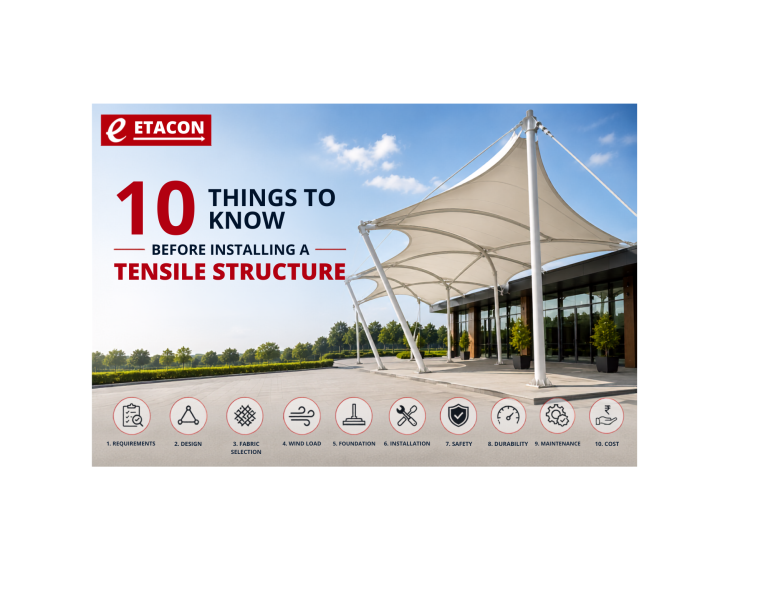
Here are 10 simple things we always suggest keeping in mind before installing a tensile structure.
1. Don’t Start with Design. Start with the Problem.
This is where a lot of people get it wrong.
They see a nice-looking design and want that exact thing.
Instead, the better question is: what problem are you trying to solve?
Maybe you need shade for children in a playground. Or maybe people are getting soaked at the entrance during the rainy season. Or perhaps your parking area becomes too hot to use in summer.
Once you understand the real need, the design usually becomes much easier to figure out.
2. Every Site Is Different
No two locations behave the same way.
Some places get strong sunlight all day. Meanwhile, others deal with heavy winds during monsoon. Some sites are tight and compact, while others are wide open.
That’s why copying a design from somewhere else usually doesn’t work very well.
A good tensile structure should be made for your space, not borrowed from someone else’s.
3. Fabric Choice Really Matters
To most people, every tensile canopy may look more or less the same.
But in reality, the fabric plays a big role in how long it lasts and how well it performs.
You’ll usually hear about PVC and PTFE fabrics.
Each one has its own strengths depending on:
- Budget
- Weather conditions
- Expected lifespan
So, there isn’t one single “best” material. The right choice depends on what your project actually needs.
4. Cheapest Is Not Always Best
Of course, everyone wants to save money. That’s completely normal.
However, the lowest price upfront can sometimes lead to bigger costs later.
Frequent repairs, early replacements, and regular maintenance can add up faster than people expect.
In the long run, spending a little more at the start often saves a lot of trouble later.
5. Good Design Doesn’t Shout
A well-designed tensile structure doesn’t need to grab attention for the wrong reasons.
Instead, it should blend in naturally with the space around it.
It should feel like it belongs there.
Whether it’s for a school, office, shopping complex, or parking area, the structure should improve the space—not look like something added at the last minute.
6. Installation Is Just as Important as Material
Even the best fabric won’t perform well if the installation is poor.
For example, alignment, tension, and fixing details all matter more than most people realize.
That’s why proper installation is so important if you want the structure to stay strong, safe, and stable for years.
7. Always Ask About Maintenance
This is one part people often forget.
Before you decide, ask questions like:
- How often does it need cleaning?
- Does it need regular inspection?
- What kind of maintenance is required?
Knowing this early helps you avoid surprises later on.
8. Think a Little Ahead
Right now, you may only need one shaded area.
But what happens next year?
Maybe your school grows. Maybe your business expands. Maybe the space gets used more often than expected.
If you plan ahead a little, you can save yourself from having to rebuild or modify things later.
9. Experience Shows in Real Projects
Every company will say they do good work.
But the real proof is in the projects they’ve already completed.
Ask to see past installations.
Also, look at how those structures have aged over time.
See whether they still look good and perform well.
That usually tells you more than any sales pitch ever could.
10. Remember Who It’s For
At the end of the day, a tensile structure isn’t really about steel or fabric.
It’s about the people using the space every day.
Students playing without worrying about the sun.
Visitors staying dry during sudden rain.
Employees walking through covered pathways comfortably.
Families enjoying outdoor areas more often.
When you keep people in mind, the right decisions become much easier.
Final Thoughts
A tensile structure is more than just a construction project.
Over time, it quietly changes how a space looks, feels, and works.
It adds comfort.
It improves usability.
It makes outdoor areas much more enjoyable.
So, before you rush into choosing a design, take a moment to think about what you really want to create.
Because in the end, the best tensile structures are not always the ones that look the most impressive.
They’re the ones people use every day without even thinking about them.
About Etacon
Etacon has been working for over 20 years on tensile structures for schools, commercial spaces, industries, hospitals, sports areas, and public projects.
From parking shades to playground canopies and walkway covers, every project starts with one simple thought:
How can this space feel more comfortable and useful for the people who use it every day?
That’s what guides every project we build.