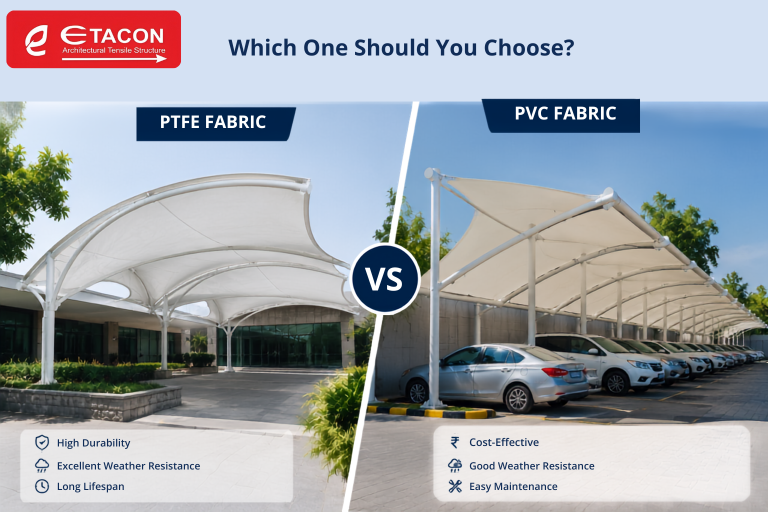
I get this question a lot: “PTFE or PVC — just tell me which one’s better.”
And every time, my answer disappoints people a little. Because there isn’t a “better” one. There’s a right one, for your project, your budget, and how long you actually need the thing to last.
Still, once you know how these two fabrics actually behave — not just what the spec sheet says, but how they hold up after five monsoons and a decade of sun — the choice usually gets a lot easier.
So let’s actually get into it.
What Are We Even Comparing?
PVC (Polyvinyl Chloride) fabric is basically a polyester weave with PVC coating layered on top. It’s cheap to produce, easy to work with, and it’s been the workhorse of the tensile industry for decades.
PTFE (Polytetrafluoroethylene) fabric is a different animal — a fiberglass base coated in PTFE resin. Costs more. Behaves differently. Lasts a lot longer.
If PVC is the fabric you use because it gets the job done, PTFE is the one you use because you never want to touch this structure again.
Lifespan
Here’s where people’s eyebrows go up.
PVC fabric holds up for roughly 10-15 years before it starts showing its age — yellowing, stiffening, losing that clean finish.
PTFE routinely pushes past 25 years. There are PTFE roofs out there from the 1970s still performing fine.
Why such a gap? PTFE just doesn’t care about UV the way PVC does. It shrugs off sunlight that would slowly cook a PVC membrane over time.
Ask yourself honestly — is this a five-year pop-up, or is it going to outlive the person who approved the budget for it?
Maintenance
Nobody signs up to babysit a roof.
PVC needs attention. Dirt clings to it, and depending on your environment, you’ll likely be recoating it at some point to keep the waterproofing intact.
PTFE, on the other hand, is almost annoyingly low-maintenance. Its surface is so non-stick that rain does most of the cleaning on its own.
I’ve seen PTFE structures that still look decent after a decade with basically zero upkeep. Try that with PVC and you’ll be disappointed.
Cost
Let’s not dance around it — this is usually what decides the argument.
PVC is cheaper. Sometimes dramatically so. For a seasonal structure, an event canopy, or anything with a shelf life measured in years rather than decades, that lower upfront cost is hard to argue with.
PTFE can run two to three times the price. But stretch that cost over 25-30 years of near-zero maintenance, and it starts looking less like an expense and more like you paid once and moved on with your life.
So the real question isn’t which one’s cheaper. It’s cheaper over what stretch of time?
Fire Safety
This one matters more than people expect until it suddenly matters a lot.
PTFE is naturally fire-resistant — it meets tough international fire codes without needing extra treatment.
PVC can be treated to improve fire resistance, but it’s not going to match PTFE’s natural performance here.
For anything public — stadiums, transit hubs, large venues — this alone often makes the decision for you.
Look and Feel
Want daylight pouring through the structure without harsh glare or heat buildup? PTFE handles that beautifully — it’s known for that soft, glowing translucency architects love.
PVC can be translucent too, but it’s more commonly chosen for its ability to hold bold colors and sharp printing. If you’re building something with heavy branding, PVC gives you room to play.
Installation
PVC bends and folds easily, which makes it friendlier for complex shapes and tighter curves during fabrication.
PTFE is stiffer. It demands more precision, more experienced hands, and generally a longer install timeline.
Neither is “wrong” here — it just changes who you need on the job and how long it’ll take.
Final Thoughts
If you made me pick one universal winner, I couldn’t — and honestly, anyone who tells you there’s one obvious answer probably hasn’t installed either of these in the field.
Ask yourself three things. How long does this actually need to last? What can you spend now versus over the next couple decades? And does the project have any real requirements around fire safety or appearance?
Once you’re honest about those answers, the fabric tends to choose itself.
About Etacon
We’ve sat across the table from a lot of clients wrestling with this exact decision.
At Etacon, we don’t just sell tensile fabric structures — we help people think through what actually fits their project, not just what’s trending or cheapest on paper.
Whether you’re leaning PTFE, leaning PVC, or genuinely can’t decide yet, we’re happy to walk through it with you — no pressure, just an honest conversation about what will actually work.
Got something in mind? Let’s talk it through.