Chances are you’ve walked under a tensile structure at some point without even clocking what it was called.
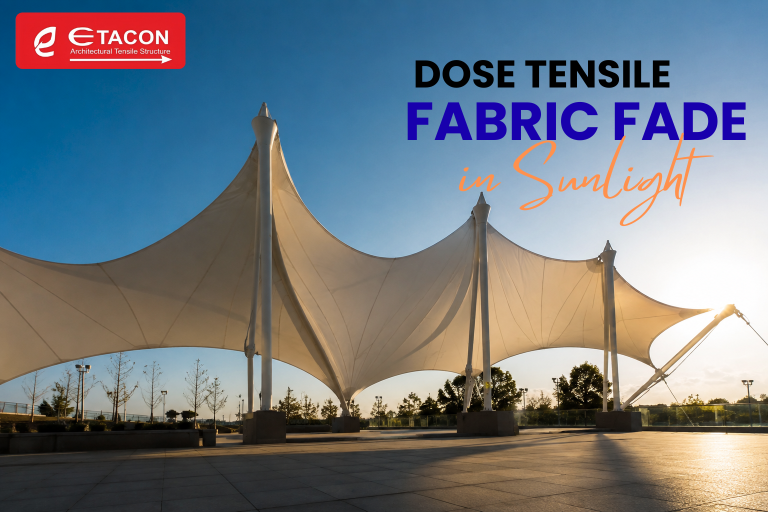
That swooping white canopy over a stadium entrance. The sail-like shade over a parking lot. The sculptural roof over an outdoor mall that makes you stop and look up for a second.
They’re striking when they’re brand new — bright white, taut, almost glowing in the sun. And that’s exactly why people start worrying about it. If it looks this good on day one, what does it look like in year ten?
So let’s actually answer it: does tensile fabric fade in sunlight?
The Honest Answer
Yes, a bit. Over time, and depending on a few things.
But before that sends you running, here’s the context that matters. Tensile fabric doesn’t fade the way, say, a cheap outdoor umbrella does after one summer. These materials are made for exactly this job — living outside, permanently, in direct sun, for decades. Fading happens, but it’s usually slow, minor, and mostly cosmetic if the right fabric was used in the first place.
Here’s what’s really going on.
It’s Not “Sunlight” Exactly — It’s UV
When people say sunlight fades things, what they really mean is UV radiation.
UV rays slowly break down molecular bonds in materials. It’s the same reason car paint dulls, garden furniture chalks up, and your deck needs restaining every few years.
Tensile membranes come with a protective top coating whose whole job is to absorb or bounce back that UV before it ever reaches the base fabric underneath. Take that coating away, and things would fade a lot faster.
Not All Tensile Fabrics Behave the Same Way
This is honestly where most of the confusion comes from. People ask “does tensile fabric fade” as if there’s one type of tensile fabric. There isn’t.
- PVC-coated polyester is the budget-friendly, common choice — but it’s also the most prone to fading and yellowing over the years, especially the cheaper grades.
- PTFE-coated fiberglass sits at the premium end. It holds color remarkably well and is what you’ll usually find on long-span, high-end structures.
- PVDF-coated polyester is a solid middle ground — better UV resistance than plain PVC, without jumping all the way to PTFE pricing.
- ETFE film is its own category entirely, but worth mentioning since it’s extremely UV stable too.
So really, the honest answer to “does it fade” is: tell me which fabric you’re using, and I’ll tell you how much.
How Fast Are We Actually Talking?
A few things decide this.
Fabric type is the big one, obviously. Climate plays a role too — a structure baking under intense year-round sun is going to show more wear than one in a cooler, cloudier region. Coating quality matters, since better coatings come with UV stabilizers built right in. And maintenance counts more than people expect — dust, pollution, and grime sitting on the surface can make a membrane look faded well before the material itself has actually degraded.
With a decent PTFE or PVDF membrane and reasonable upkeep, you’re often looking at 15 to 25+ years before you’d notice much of a visible change.
Fading Isn’t the Same as Weakening
This one trips people up a lot, so it’s worth saying clearly: a change in surface color does not mean the structure is losing strength.
The tensile strength of the membrane comes from the base fabric weave, not the surface coating. So if you spot a slight shift toward off-white, or a bit of a chalky texture years down the line, that’s almost always cosmetic. It’s not a structural red flag.
Still, it’s worth having your structure looked at periodically. Not because fading means failure, but because any outdoor structure benefits from a regular check-in.
Can You Actually Slow It Down?
Yes, and a lot of it comes down to decisions made before installation even starts.
Pick a fabric grade suited to your climate and budget, rather than defaulting to whatever’s cheapest. Go with a coating from a manufacturer known for quality, not just a low price tag. Clean the surface periodically, since built-up grime speeds up wear far more than most people realize. And work with installers who know how to tension the fabric properly, because uneven tension creates stress points that age faster and more unevenly than the rest of the structure.
None of these are dramatic steps. But together, they’re the difference between a structure that looks tired in year eight and one that still looks sharp in year twenty.
Final Thoughts
So, does tensile fabric fade in sunlight? A little, yes — that’s just physics, and no outdoor material is completely immune to years of UV exposure.
But with the right fabric, a good coating, and a bit of routine care, that fading stays slow, subtle, and purely cosmetic. It won’t eat into the strength or the lifespan of your structure.
If you’re planning a tensile project and want something that still turns heads a decade from now, the fabric choice is where that story starts.
About Etacon
At Etacon, we design and install tensile structures built to hold up — visually and structurally — for the long haul. From choosing the right fabric to getting the tensioning exactly right, we handle every detail with durability and appearance in mind. Reach out to us to talk through your next tensile structure project.