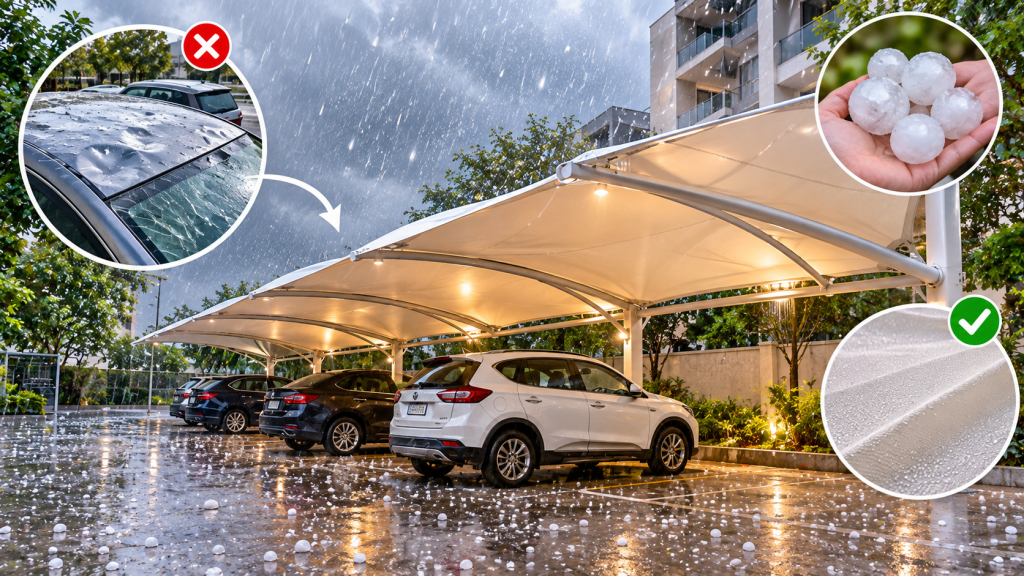
It was a Tuesday evening in March when the sky over Gurugram turned the colour of slate. Twenty minutes later, hailstones the size of marbles hammered every car in a society parking lot. Cars on one side got dented roofs and cracked windscreens. The cars under the tensile shade on the other side came out clean.
The next morning the society secretary called us. “The fabric survived?” he asked, half-disbelieving.
It had. And that’s the usual story with tensile structure hail damage, though not every story ends so well. Here’s what a fabric roof really handles, where it can fail, and what you can do about it.
Quick answer: A tensile fabric roof flexes under impact, so it absorbs small and medium hail without breaking. Glass and rigid sheets can crack or dent instead. Very large hail, sharp flying debris, or old, weak fabric can still puncture or dent the surface. Choose a heavier, higher-grade fabric, keep the tension right, trim nearby trees, and inspect the roof after every big storm.
Why Does Fabric Handle Hail Better Than Rigid Roofs?
Think about hitting a tight drum versus a sheet of glass. The drum bounces the impact. The glass breaks.
A tensioned membrane works the same way. It stretches slightly under a hit, spreads the force across a wider area, and returns to shape. Rigid roofs can’t flex like that. Polycarbonate can crack, thin metal sheets dent, and glass shatters.
The slope helps too. Hailstones roll off a curved roof quickly instead of piling up. Less weight sits on the structure, and less melting ice pools on the surface.
When Can Hail or Debris Actually Cause Damage?
Fabric isn’t indestructible. A few situations cause real trouble.
Very large hail. Delhi NCR sometimes sees big stones in March and April. Hailstones as big as golf balls or larger can leave dents or punctures, especially on thin PVC.
Sharp debris. Storms throw things. Tree branches, broken sheets from nearby construction, and loose wire can slice through fabric. Kite strings and sharp thread, common near festivals, can cut thin spots too.
Old, brittle fabric. Fabric that’s 12 or 15 years old loses flexibility. It breaks where fresh fabric would bounce. Regular inspection catches this early.
Loose tension. A sagging roof flaps in wind and takes impact badly. Proper tension keeps the membrane springy and stable.
What Design Choices Reduce the Risk?
Most of the protection comes from good decisions before the roof goes up.
Pick a stronger fabric. Heavier, higher-grade membranes resist impact better. PVDF and PTFE-coated glass fabrics are tougher against sharp objects, while thin PVC suits lower-risk sites. Ask your supplier about fabric weight and tear strength.
Consider a double-layer roof. The outer layer takes the hit, and the air gap softens it. It also reduces noise during a hailstorm, which is a nice side benefit.
Keep the fabric properly tensioned. Your installer should check tension at handover and again after the first monsoon.
Keep trees trimmed. Branches overhanging the roof are the most common source of puncture damage. A quick prune before storm season costs little.
What Should You Do After a Storm?
Don’t climb on the roof. That’s how people get hurt and fabric gets damaged.
First, look from the ground. Check for dents, holes, loose edges, or sagging patches. Look at the floor too. Water stains below the fabric often show a leak you can’t see from above.
Second, check the frame. Look at the joints, cable ends, and base plates for movement or bent parts.
Third, call a professional if you spot anything odd. They can reach the roof safely and tell you whether a patch will do. Small tears fix easily if you act early. Left alone, they can spread in the next wind.
Can Damaged Fabric Be Repaired?
Usually yes. Small punctures and tears take a welded or glued patch, and the repair is often quick and affordable. Larger damage may need a new panel. A good fabricator replaces just the affected section, not the whole roof, so ask about that.
Keep records of the repair, and mention it to your warranty provider if the damage was storm-related. Some policies cover natural events, and some don’t, so read the terms. You can read more about how we handle repairs on our Our Services page.
Frequently Asked Questions
Can hail puncture a tensile roof?
Small and medium hail usually can’t. Large hail, sharp debris, or old brittle fabric can leave dents or punctures. Fabric grade and tension matter a lot.
Is fabric safer than a polycarbonate roof in hail?
Often, yes. Fabric flexes and absorbs impact, while rigid sheets can crack. The exact result depends on the product and the hail size.
Can a damaged fabric roof be repaired?
Usually. Small tears take a patch, and bigger damage may need a replacement panel. Early repair keeps small problems from spreading.
Final Thought
A fabric roof is tougher than it looks, but it isn’t magic. Pick a fabric grade that matches your risk, keep the tension right, and prune nearby trees before storm season. After every big storm, look first and climb never. If you’d like help choosing, browse our Our Products page. For background on the weather itself, this overview of hail is a good start, and this one explains the roof: tensile structure.
About Etacon
Etacon is a tensile structure manufacturer based in Gurugram, Delhi NCR. The company has been making tensile structures and canopy solutions since 2004, and it works on residential, commercial, industrial, and public projects across India. Etacon designs, fabricates, and installs car parking shades, entrance canopies, walkway covers, gazebos, facades, and custom fabric structures. Explore the full range on the Our Products page, or read about the design and installation process on the Our Services page.
Contact Etacon
Etacon: Architectural Tensile Structure Ground Floor, 606/2A, Sector 37, Pace City I, Sector 10A, Gurugram, Haryana 122001 Phone: +91-9873310328, +91-9818048428, 0124-4266119 Email: sales@etacon.co.in Website: etacon.co.in Managing Director: Mr. Prabhu Patil
Keywords: tensile structure hail damage, hail resistant fabric roof, tensile roof storm damage, fabric roof hailstorm, parking shade hail protection, tensile fabric puncture repair, storm damage canopy, tensile structure debris impact, hailstorm Delhi NCR, tensile structure Gurugram