
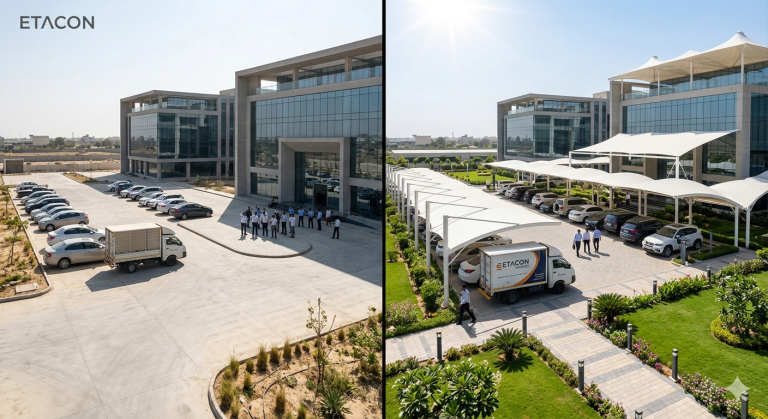
When most people hear the word construction, they imagine buildings.
They think of walls going up, rooms taking shape, and large structures slowly coming together.
And for a long time, that was how we defined a space.
If people needed somewhere to gather, work, wait, or move around comfortably, the solution was usually to build another room or another building.
But if you look around today, you’ll notice something interesting.
Some of the most useful and enjoyable spaces don’t actually have walls at all.
They’re open.
They’re connected to the outdoors.
And yet, people naturally want to spend time there.
That’s because creating a great space isn’t always about enclosing people. Sometimes it’s about understanding how they live, move, and interact with their surroundings.
We Enjoy Being Outside More Than We Think
The truth is, most people like open spaces.
We enjoy natural light.
We enjoy fresh air.
We enjoy feeling connected to the environment around us.
The problem isn’t being outside.
The problem is being uncomfortable outside.
Standing in the middle of a parking lot under the afternoon sun isn’t enjoyable.
Walking through heavy rain between buildings isn’t enjoyable.
Waiting in an exposed area isn’t enjoyable.
But give people a little shade, a little shelter, and a little comfort, and suddenly that same outdoor area becomes a place they actually want to use.
Some of the Best Spaces Aren’t Rooms
Think about the places where people naturally gather.
A covered entrance outside a hotel.
A shaded seating area in an office complex.
A walkway connecting two buildings.
A comfortable outdoor waiting area.
Technically, these aren’t rooms.
Yet they’re often some of the most used spaces on a property.
People stop there.
Talk there.
Wait there.
Meet there.
They become part of everyday life without anyone really thinking about it.
And that’s what makes them so valuable.
Good Design Feels Effortless
Have you ever visited a place that just felt easy to move through?
Nothing stood out dramatically.
Nothing demanded attention.
Yet everything felt comfortable.
You knew where to walk.
You knew where to wait.
You felt protected from the weather.
The entire experience felt natural.
That’s usually a sign of good design.
The best spaces don’t force people to adapt to them.
They adapt to the people using them.
The Space Between Buildings Matters Too
One thing many property owners discover is that the areas around a building can be just as important as the building itself.
The parking area.
The pathway.
The entrance.
The outdoor gathering space.
These are often the first places people experience.
And sometimes they’re the places people spend the most time.
A beautiful building can lose some of its impact if the journey to reach it feels inconvenient.
On the other hand, when outdoor spaces are comfortable and thoughtfully designed, the entire property feels better.
Creating Comfort Without Closing Things Off
There’s something special about a space that feels protected while still feeling open.
You can enjoy the breeze.
You can see the surroundings.
Natural light still fills the area.
Yet you’re protected from harsh weather.
That’s why modern architecture has increasingly embraced open-air covered spaces.
They offer the best of both worlds.
People stay connected to the outdoors while enjoying the comfort usually associated with indoor environments.
Modern Spaces Are Becoming More Human
The way we design properties is changing.
Today, the conversation isn’t just about square footage or construction costs.
It’s also about experience.
How do people move through the property?
Where do they gather?
What makes them feel comfortable?
How can outdoor areas become more useful?
These questions are becoming just as important as the design of the building itself.
And that’s a positive change.
Because great spaces should be designed around people, not just structures.
It’s Never Just About the Structure
When someone sees a canopy, a tensile structure, or a covered walkway, they often see the physical object.
But the real value isn’t the structure itself.
The real value is what it creates.
A more comfortable arrival.
A better place to wait.
A shaded parking area.
An outdoor space that people actually enjoy using.
The structure is simply the tool.
The experience is what matters.
Final Thoughts
For years, we measured spaces by the walls that surrounded them.
Today, we’re starting to see things differently.
A meaningful space doesn’t always need doors, windows, or enclosed rooms.
Sometimes all it needs is purpose, comfort, and thoughtful design.
Because at the end of the day, people don’t care whether a space has four walls.
They care about how it makes them feel.
And often, the spaces that leave the strongest impression are the ones that remain open, welcoming, and connected to the world around them.
That’s the real art of creating spaces without building walls.
About Etacon
At Etacon, we believe great spaces are about more than construction.
For over 20 years, we’ve been helping businesses, institutions, and property owners create outdoor environments that feel comfortable, functional, and inviting.
Whether it’s a tensile structure, a covered walkway, a parking solution, or a custom architectural project, our focus is always on the people who will use the space every day.
Because a well-designed structure isn’t just something you see.
It’s something you experience.