
Spend a Saturday morning at any sports academy and you’ll see a lot more than a game being played.
You’ll see young athletes arriving early, still rubbing sleep from their eyes while carrying oversized kit bags. You’ll see coaches setting up cones and equipment before the first session begins. You’ll see parents finding a place to sit, coffee in hand, preparing to spend the next few hours cheering from the sidelines.
By the time the first whistle blows, the venue is already full of activity.
That’s why it’s always interesting when people talk about sports facilities as if they’re only about the playing field.
The field is important, of course.
But anyone who regularly spends time at sports venues knows the experience is much bigger than that.
The Reality of Outdoor Sports
Let’s be honest.
Most sports don’t stop because the sun is too strong.
Practice sessions still happen.
Tournaments still go ahead.
Matches still need to be played.
But anyone who has attended a sports event in the middle of summer knows how quickly the excitement can disappear when you’re standing in direct sunlight for hours.
Players get exhausted faster.
Spectators become uncomfortable.
Parents start looking for shade wherever they can find it.
Suddenly, everyone’s attention shifts from the game to the weather.
And that’s never a good sign.
The Game Might Last an Hour. The Day Usually Doesn’t.
A football match may last ninety minutes.
A cricket game might take an entire afternoon.
A tournament can easily stretch across a full day.
The reality is that players, coaches, parents, and spectators spend far more time around the game than actually watching it.
They’re arriving early, waiting between matches, discussing performances, grabbing refreshments, and looking for somewhere comfortable to sit while the next game gets underway.
Those moments become a huge part of the overall experience.
And that’s exactly where many facilities either get things right or get them wrong.
Athletes Need Recovery Spaces Too
One thing many people overlook is that athletes don’t spend all their time competing.
In fact, a large part of sports is waiting.
Waiting for practice to begin.
Waiting between matches.
Waiting for instructions.
Waiting to recover before the next session.
Those moments matter.
A young cricketer sitting under shade between matches.
A football team discussing tactics before stepping onto the field.
A tennis player cooling down after a long game.
These experiences become much more comfortable when facilities are designed with people in mind.
Parents Remember Comfort More Than the Score
Ask any parent who’s spent weekends at sports academies and they’ll tell you the same thing.
They may not remember every score.
But they’ll definitely remember whether the facility was comfortable.
Whether there was shade.
Whether there was protection from unexpected rain.
Whether sitting through a three-hour tournament felt enjoyable or exhausting.
These small details have a huge impact on how people feel about a sports venue.
And often, they influence whether people want to come back.
Modern Sports Facilities Are Thinking Beyond the Game
The best sports facilities today understand that they’re not just hosting matches.
They’re hosting people.
Athletes.
Families.
Coaches.
Officials.
Visitors.
Everyone experiences the venue differently.
That’s why modern sports complexes are investing in covered seating areas, shaded walkways, player waiting zones, practice shelters, and gathering spaces.
Because the goal isn’t simply to create a place to play.
It’s to create a place where people enjoy spending time.
Why Tensile Structures Work So Well in Sports Environments
One of the biggest challenges in sports facility design is finding a balance.
People want protection from the weather.
But they don’t want to feel closed in.
Sports are meant to feel open.
The fresh air.
The natural light.
The connection to the outdoors.
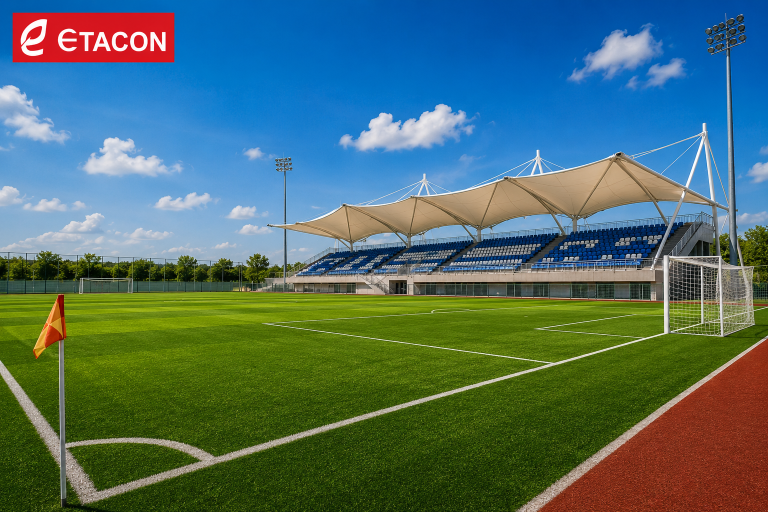
That’s exactly why tensile structures have become such a popular solution.
They provide shelter without taking away the open atmosphere that makes outdoor sports enjoyable.
Whether it’s spectator seating, player rest zones, walkways, or training areas, tensile structures create comfortable spaces while keeping the venue bright and welcoming.
It’s Not About the Structure
This might sound surprising coming from a company that builds tensile structures, but the real value isn’t the structure itself.
It’s what the structure allows people to do.
Stay longer.
Feel comfortable.
Enjoy the event.
Focus on the game instead of the weather.
That’s what people remember.
Nobody leaves a sports venue talking about the engineering details of a canopy.
But they do remember feeling comfortable while watching their child score the winning goal.
They remember being able to enjoy a tournament without standing under the scorching sun.
That’s the real impact.
Final Thoughts
A great sports facility isn’t defined only by the quality of its playing field.
It’s defined by the experience it creates for everyone who uses it.
The athletes.
The parents.
The coaches.
The spectators.
Because sports are about people.
And when people feel comfortable, they stay longer, enjoy more, and create better memories.
Sometimes, the most valuable part of a sports facility isn’t where the game is played.
It’s the space that helps people enjoy everything around it.
About Etacon
At Etacon, we’ve spent more than 20 years helping schools, academies, clubs, and sports venues create outdoor spaces that people genuinely enjoy using.
From spectator seating covers and player shelters to walkways and custom tensile structures, we focus on designing solutions that improve comfort without taking away the open spirit of sports.
Because at the end of the day, great sports facilities aren’t just built for matches.
They’re built for the people who make those matches memorable.