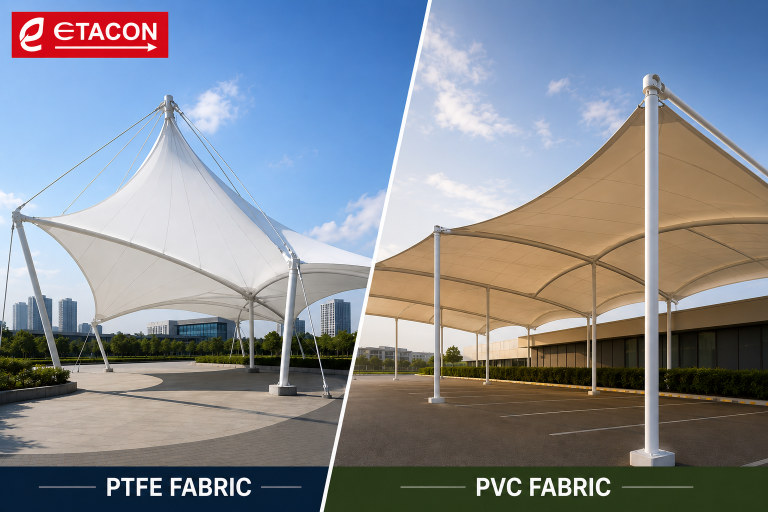
If you’ve started exploring tensile structures, you’ve probably come across the terms PTFE and PVC more times than you’d like.
And if you’re like most property owners, facility managers, or architects, you’ve probably asked the same question everyone asks:
“Which one should I choose?”
The problem is that most explanations quickly become technical.
Before you know it, you’re reading about coatings, membranes, tensile strength, and chemical properties when all you really want to know is whether the structure will look good, last long, and justify the investment.
The good news?
Fortunately, choosing between PTFE and PVC isn’t as complicated as it sometimes sounds.
In fact, it often comes down to a few simple questions about how you plan to use the space.
First, Let’s Clear Up a Common Misconception
Many people assume that one fabric is “good” and the other is “better.”
However, that’s not really how it works.
It’s a bit like choosing between two cars.
One might be more premium and last longer, while the other offers excellent value and does everything most people need.
Neither choice is wrong.
Instead, they’re simply designed for different situations.
The same applies to PTFE and PVC fabrics.
Both have been used successfully in thousands of tensile projects around the world.
So, the key is understanding where each one performs best.
Why So Many Projects Use PVC Fabric
Let’s start with the fabric most people encounter every day.
If you’ve visited a commercial complex, parked under a tensile car shed, walked through a covered pathway at a school, or waited beneath an entrance canopy, chances are you’ve already experienced a PVC tensile structure.
Most people don’t realize it because they’re not looking at the fabric.
Instead, they’re enjoying the shade.
They’re staying dry during the rain.
They’re moving comfortably through the space.
And that’s exactly the point.
PVC works because it quietly does its job.
For many projects, it offers the right combination of appearance, durability, and affordability.
As a result, PVC remains one of the most popular tensile fabric choices across India.
Where PTFE Starts to Stand Out
Now imagine a large airport terminal.
A major sports stadium.
A convention center designed to serve thousands of visitors every day.
These are the kinds of projects where PTFE often enters the conversation.
PTFE isn’t popular because it looks dramatically different on day one.
Rather, it’s valued for how well it performs over many years.
It handles harsh sunlight exceptionally well.
In addition, it resists dirt more effectively.
It requires less maintenance.
Most importantly, it tends to maintain its appearance for a very long time.
That’s why architects often choose it for projects expected to become long-term landmarks.
The Question Clients Ask Most Often
After discussing features and benefits, the conversation usually comes back to one thing:
“How long will it last?”
It’s a fair question.
After all, nobody wants to invest in a structure that looks great for a few years and then becomes a maintenance headache.
Generally speaking, PTFE offers a longer lifespan than PVC.
However, that doesn’t automatically mean PTFE is the right choice for every project.
If you’re building a car parking structure, a covered walkway, or a commercial canopy, a quality PVC solution may provide decades of reliable performance at a more practical investment level.
Therefore, the decision should never be based on lifespan alone.
What Works Best in Indian Weather?
This is where experience becomes important.
India isn’t an easy environment for outdoor structures.
We deal with intense summer heat, heavy monsoon rains, dust, humidity, and everything in between.
Fortunately, both PVC and PTFE fabrics can perform extremely well when they’re properly designed and installed.
So, the bigger question is usually how the structure will be used.
For many commercial and institutional projects, PVC delivers excellent performance and value.
On the other hand, for high-profile developments where longevity and architectural impact are priorities, PTFE often becomes the preferred option.
The Better Question to Ask
Over the years, we’ve noticed that clients sometimes focus too much on the material itself.
However, the more useful question isn’t:
“Which fabric is better?”
It’s:
“Which fabric is better for my project?”
Because every project is different.
A school doesn’t have the same requirements as an airport.
Similarly, a commercial complex doesn’t have the same priorities as a stadium.
Ultimately, the best choice depends on your goals, your budget, and how you expect the structure to perform over time.
Final Thoughts
The PTFE vs PVC conversation doesn’t need a winner.
Both fabrics have earned their place in modern tensile architecture.
PVC continues to be the practical choice for countless successful projects because it offers excellent value and reliable performance.
Meanwhile, PTFE remains the premium option for projects where long-term durability and minimal maintenance are critical.
Overall, the right decision isn’t about choosing the most expensive fabric or the most popular one.
It’s about choosing the fabric that makes the most sense for the space you’re creating.
About Etacon
At Etacon, we’ve spent more than 20 years helping clients make exactly those decisions.
Whether it’s a school looking for a durable walkway cover, a commercial property planning a car parking structure, or a large-scale development exploring premium PTFE solutions, our approach is always the same.
We start by understanding how people will use the space.
Because the best tensile structures aren’t defined by the fabric alone.
They’re defined by how well they serve the people who use them every day.