
Most people have seen a tensile structure without ever really thinking about it.
Maybe it was covering the parking area outside an office.
Maybe it was the canopy over a school playground where children were running around during recess.
Or perhaps it was outside a hospital, giving visitors a little relief from the afternoon sun while they walked to the entrance.
It blends into the surroundings so naturally that people often don’t stop to ask how it actually works.
Until one day they do.
“How is that roof standing there?”
It’s a fair question.
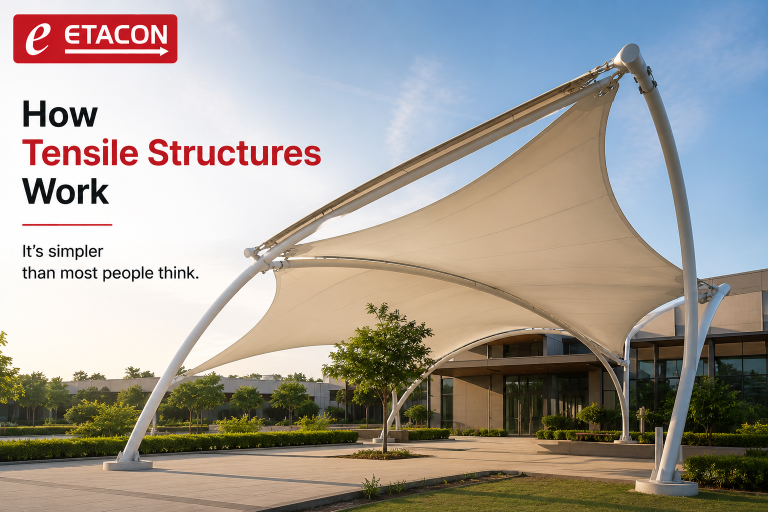
Unlike a traditional roof, it doesn’t look heavy. There aren’t thick concrete slabs or rows of metal sheets. Instead, there’s a fabric stretched across a steel frame, almost as if it’s floating.
It looks light.
But appearances can be misleading.
The Secret Isn’t the Fabric. It’s the Way Everything Works Together.
When people hear the word fabric, they often imagine something soft or delicate.
The fabric used in tensile structures is nothing like that.
It’s manufactured to stay outdoors for years. It faces scorching summers, heavy monsoon rain, dust, pollution, and strong winds without losing its purpose.
Still, the fabric isn’t doing the job alone.
What makes a tensile structure strong is the way every part supports the others.
The steel frame holds the fabric in position.
The fabric stays under carefully controlled tension.
Together, they create a structure that’s both lightweight and remarkably strong.
It’s teamwork more than anything else.
Imagine Pulling a Piece of Cloth
Here’s an easy way to picture it.
Imagine holding a bedsheet by its corners.
If everyone pulls gently at the same time, the sheet becomes smooth and tight.
It suddenly feels stronger than it did lying loose on the bed.
Now imagine letting go of one corner.
The whole thing loses its shape almost immediately.
A tensile structure follows the same basic idea—only with engineered steel, specialised fabric, and precise calculations behind it.
The fabric is stretched just enough to stay stable, even when the weather changes.
Those Curves Aren’t Just There to Look Beautiful
One thing people often notice is the shape.
Very few tensile structures are perfectly flat.
Some rise in the middle.
Others sweep down at the edges.
Some almost look like sails catching the wind.
It certainly makes them look attractive.
However, that’s not why they’re designed that way.
Those curves help rainwater run off instead of collecting on the roof.
They reduce pressure from strong winds.
They also help keep the fabric evenly stretched across the entire structure.
In other words, the design isn’t only about appearance.
It’s helping the structure do its job.
Why Don’t Tensile Structures Feel Closed In?
This is something people notice without always realising it.
Stand beneath a concrete roof and the space feels enclosed.
Stand beneath a tensile structure and it feels completely different.
There’s still daylight.
Fresh air continues to move through the area.
You still feel connected to what’s happening outside.
That’s exactly why tensile structures have become so popular in schools, cafés, sports facilities, hospitals, and commercial buildings.
People want protection from the weather.
They don’t want to lose the feeling of being outdoors.
A tensile structure gives them both.
Every Project Begins with a Different Question
People sometimes ask us,
“Which tensile structure is the best?”
The honest answer is…
There isn’t one.
A school playground has different needs than a hotel entrance.
A factory loading area isn’t designed the same way as a cricket academy.
Even two office buildings in different locations might need completely different solutions because of the available space, local weather, or the way people use the area.
That’s why every project starts with questions rather than drawings.
Understanding the space always comes first.
Most People Never Notice the Engineering
And that’s actually a good thing.
When a tensile structure is designed properly, nobody talks about the steel frame.
Nobody thinks about the fabric tension.
Nobody notices how rainwater flows away or how the wind moves around the roof.
People simply enjoy the shade.
They park their car.
They watch their child’s football match.
They walk into the building without getting wet.
The engineering quietly does its job in the background.
That’s probably the biggest compliment any structure can receive.
Final Thoughts
A tensile structure might look simple from a distance, but there’s a lot of thoughtful engineering behind that simplicity.
It’s not held together by one material or one component.
Instead, it’s the balance between fabric, steel, design, and engineering that makes everything work.
And perhaps that’s the real beauty of a tensile structure.
It doesn’t try to dominate the space around it.
It simply makes that space more comfortable for the people using it.
Sometimes, that’s exactly what good design is supposed to do.
About Etacon
For more than 20 years, Etacon has been designing tensile structures for schools, businesses, hospitals, sports facilities, industries, and commercial spaces across India.
Every project starts the same way—not by choosing a fabric or drawing a roof, but by understanding how people will use the space every day.
Because when you understand people first, building the right structure becomes much easier.