If someone had asked this question 15 or 20 years ago, the answer would have been simple.
Need a roof?
Build one with concrete or metal sheets.
That was the standard solution, and for many buildings, it still is.
But walk around any modern school, office campus, shopping complex, sports facility, or hospital today, and you’ll notice something has changed.
Outdoor spaces are no longer being treated as leftover areas.
They’re becoming places where people spend time.
People walk through them.
Wait in them.
Meet in them.
Work in them.
And that small shift has changed the way we think about roofing.
Today, the question isn’t simply “How do we cover this space?”
It’s “How do we make this space comfortable without losing its openness?”
That’s exactly where tensile structures have found their place.
Every Roof Has a Job to Do
Whether it’s made from concrete, metal, or tensile fabric, every roof serves the same basic purpose.
It protects people from the sun.
It keeps the rain away.
It makes outdoor spaces more usable.
So, if both traditional roofing and tensile structures can do that, why are more businesses choosing tensile structures?
The answer has less to do with the roof itself and more to do with the people standing underneath it.
Think About the Last Time You Walked Across a Parking Area
Imagine it’s the middle of May.
You’ve just stepped out of your office after a long meeting.
Your car is parked a short distance away.
There are two routes.
One is completely open under the afternoon sun.
The other has a well-designed tensile canopy providing shade all the way to the parking area.
Most of us wouldn’t even think twice.
We’d naturally choose the shaded path.
Not because someone told us to.
Because comfort is something we instinctively look for.
Good design works the same way.
People don’t notice it because it’s flashy.
They notice it because it makes everyday life easier.
Traditional Roofing Still Has Its Place
Let’s be clear.
This isn’t about saying traditional roofing is outdated.
It isn’t.
If you’re building a house, a warehouse, or an enclosed office, concrete and steel roofs are exactly what you’d expect.
They’re strong, dependable, and built for permanent indoor spaces.
The real difference appears when the space is meant to stay open.
Think about a school playground.
A café’s outdoor seating area.
A covered walkway between two buildings.
Or the entrance to a commercial complex.
Closing these spaces with heavy roofing often changes the feeling completely.
They lose the openness that made them inviting in the first place.
That’s Why Tensile Structures Feel Different
One thing people often say after visiting a property with a tensile structure is that the space feels… lighter.
It’s difficult to explain until you’ve experienced it yourself.
Natural daylight still reaches the area.
Fresh air continues to flow through the space.
You feel protected from the weather without feeling boxed in.
That’s one of the biggest reasons tensile structures have become so popular over the last decade.
They don’t replace the outdoors.
They improve it.
Design Matters More Than Ever
Modern architecture isn’t only about constructing bigger buildings.
It’s about creating better experiences.
When someone visits your office, school, or commercial property, they begin forming an opinion before they even walk through the entrance.
A clean walkway.
Comfortable parking.
A welcoming outdoor seating area.
These details quietly influence how people feel about the place.
A tensile structure isn’t just there to provide shade.
It becomes part of the overall experience.
And often, it’s one of the first things visitors notice.
Looking Beyond the Initial Cost
One conversation we have quite often is about budget.
That’s understandable.
Every project has financial limits.
But choosing a roofing solution shouldn’t come down to the lowest quotation alone.
Instead, think about how the space will be used over the next ten or twenty years.
Will people actually enjoy spending time there?
Will it improve the appearance of the property?
Will it reduce maintenance compared to other options?
Sometimes, the better investment isn’t the cheapest one.
It’s the one that continues creating value long after the installation is complete.
It’s Not Really About the Roof
This might sound surprising coming from a company that designs tensile structures, but the roof itself isn’t the most important part of the project.
The people are.
The students walking comfortably between classrooms.
The customer arriving at your showroom.
The employee heading towards the parking area.
The family attending an outdoor event.
They’re the reason the structure exists.
When you start designing around people instead of products, you usually end up creating much better spaces.
So, Which One Should You Choose?
The truth is, there’s no universal answer.
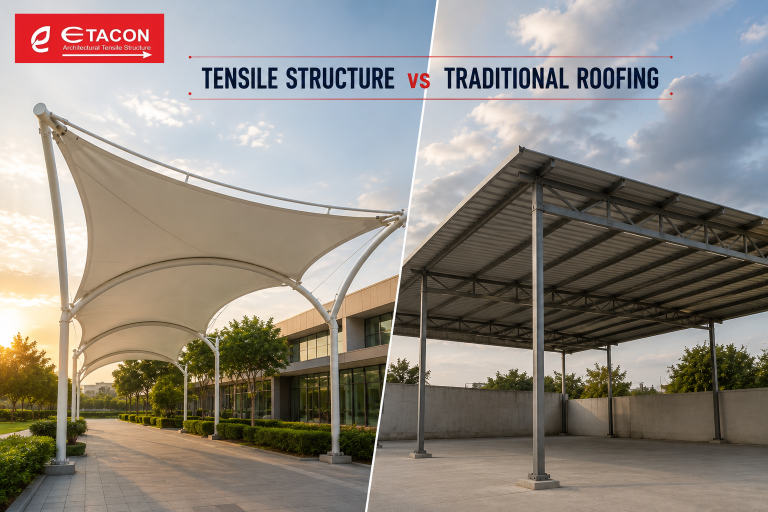
Traditional roofing continues to be the right choice for enclosed buildings where strength and permanence are essential.
Tensile structures, on the other hand, are designed for spaces that need to remain open, welcoming, and comfortable.
It’s not about one being better than the other.
It’s about choosing the solution that fits the purpose of the space.
Final Thoughts
A roof can do more than protect people from the weather.
It can make a workplace more welcoming.
It can encourage students to spend more time outdoors.
It can make customers feel more comfortable before they even step inside a building.
That’s why the conversation today is no longer just about roofing materials.
It’s about creating spaces people genuinely enjoy using.
Because in the end, people rarely remember what a roof was made of.
They remember how the space beneath it made them feel.
About Etacon
At Etacon, we’ve spent more than 20 years helping businesses, schools, industries, hospitals, and commercial properties create outdoor spaces that are practical, comfortable, and built to last.
Whether it’s a car parking canopy, a covered walkway, a playground shade structure, or a large architectural tensile roof, we don’t begin by asking, “What should we build?”
We begin by asking, “How can this space work better for the people who use it?”
Because that’s what great design is really about.