Anyone who has worked on a tensile project in India knows the weather here is not exactly cooperative.
You’ll get three months of brutal heat where the sun feels personal. Then the monsoon rolls in and doesn’t let up for weeks. Throw in dust storms in the north, salt air on the coasts, and humidity that never really goes away in the south, and you start to see the problem.
Picking a fabric for a tensile structure in this kind of climate is not a small decision. It’s the decision that determines whether your structure is still standing strong in ten years or falling apart in three.
We’ve seen both outcomes. Here’s what we’ve learned actually holds up.
PVC Coated Polyester
This is the fabric you’ll see most often on Indian tensile projects, and honestly, it’s earned that spot.
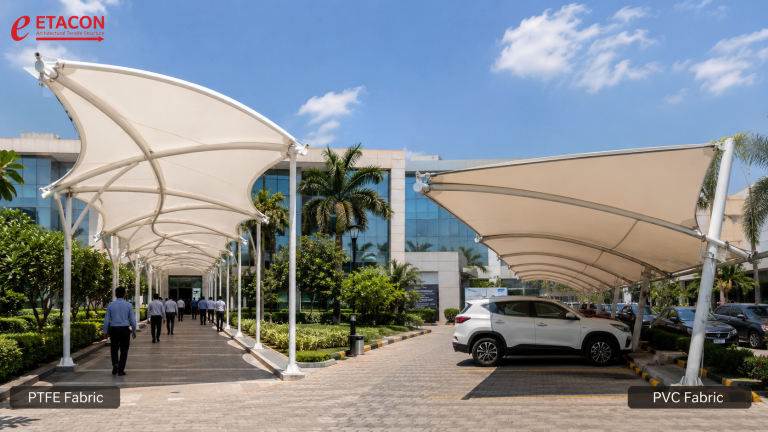
It’s budget-friendly, reasonably tough, and does a solid job in average weather. For parking sheds, walkways, and smaller canopy jobs, it’s usually the right call.
One thing though. If your project sits somewhere humid or gets pounded by monsoon rain every year, plain PVC without anti-fungal treatment will let you down. We’ve replaced more than a few canopies that skipped this step. Ask for it upfront, not after the fungus shows up.
PTFE Coated Fiberglass
If budget isn’t the main constraint and you want something that basically ignores time, this is it.
PTFE fiberglass is fire resistant, sheds dirt on its own, and doesn’t flinch under UV exposure. We’ve seen these fabrics still look decent after two and a half decades in the field.
It costs more upfront, no question. But for airports, stadiums, and big commercial jobs where replacing the roof isn’t a quick fix, the math usually works in its favor.
It also handles heat exceptionally well, which matters a lot in places like Rajasthan or Gujarat where summer isn’t really a season so much as a test.
PVDF Coated Polyester
Think of this as PVC’s more resilient sibling.
It stands up better to pollution, UV, and general chemical wear over time. In cities where the air quality isn’t great, this fabric keeps its color and strength for a lot longer than standard PVC would.
It sits nicely in the middle price-wise too. Not as expensive as fiberglass, but noticeably better than basic PVC. We tend to recommend it for restaurants, retail spaces, and commercial canopies where appearance matters just as much as durability.
Coastal Projects Need Extra Care
Working near the coast changes things.
Salt in the air eats through coatings and fittings faster than most people expect. We’ve seen structures in Mumbai and Chennai age years ahead of schedule simply because the fabricator didn’t account for salt exposure.
If your project is anywhere near the water, ask directly about salt-resistant coatings and corrosion-proof fittings. It’s a small conversation that saves a lot of money down the line.
GSM and Thickness Matter More Than People Think
There’s a temptation to save money by going with a thinner, lower GSM fabric. We get it, budgets are real.
But GSM (grams per square meter) has a direct effect on how well the fabric handles wind, heavy rain, and general wear. Cut corners here in a high-wind or heavy-rain region, and you’re likely looking at repairs sooner than planned.
Match the fabric weight to your region’s actual weather, not just the quote on the invoice.
Don’t Underestimate the Monsoon
A question worth asking before any installation: where does the water go?
Even the best fabric in the world will sag or tear if water pools on top of it instead of draining off. We’ve inspected structures where the fabric was fine but the drainage design was the actual failure point.
Make sure the slope and tensioning are built specifically with monsoon conditions in mind, not just for dry, calm weather.
UV Treatment Isn’t Optional
Indian summers don’t go easy on anything left out in the open for months.
Untreated fabric fades, weakens, and gets brittle a lot faster than people expect, sometimes within a year or two. UV-stabilized fabric costs a bit more, but it’s one of those upgrades that pays for itself.
Final Thoughts
There’s no single “best” fabric for every project. It really comes down to your region, your budget, and what the structure needs to do.
PVC is a solid, dependable choice for everyday needs. PTFE fiberglass makes sense when longevity matters more than upfront cost. PVDF sits comfortably in between the two.
Whichever direction you go, don’t treat the fabric choice as the only decision that matters. Coating quality, GSM, UV protection, and proper drainage design all play a part. Skip any of these, and even the best fabric on paper won’t perform the way it should.
Get the details right, and your structure won’t just survive the Indian weather. It’ll hold up to it, season after season.
About Etacon
Etacon designs and builds tensile structures suited to Indian conditions, from parking sheds to large commercial canopies. Our focus stays on getting the material choice, engineering, and installation right the first time, so the structures we build hold up well beyond the first monsoon or summer. If you’re planning a tensile project and want it built to actually last, we’re happy to talk through what makes sense for your site.