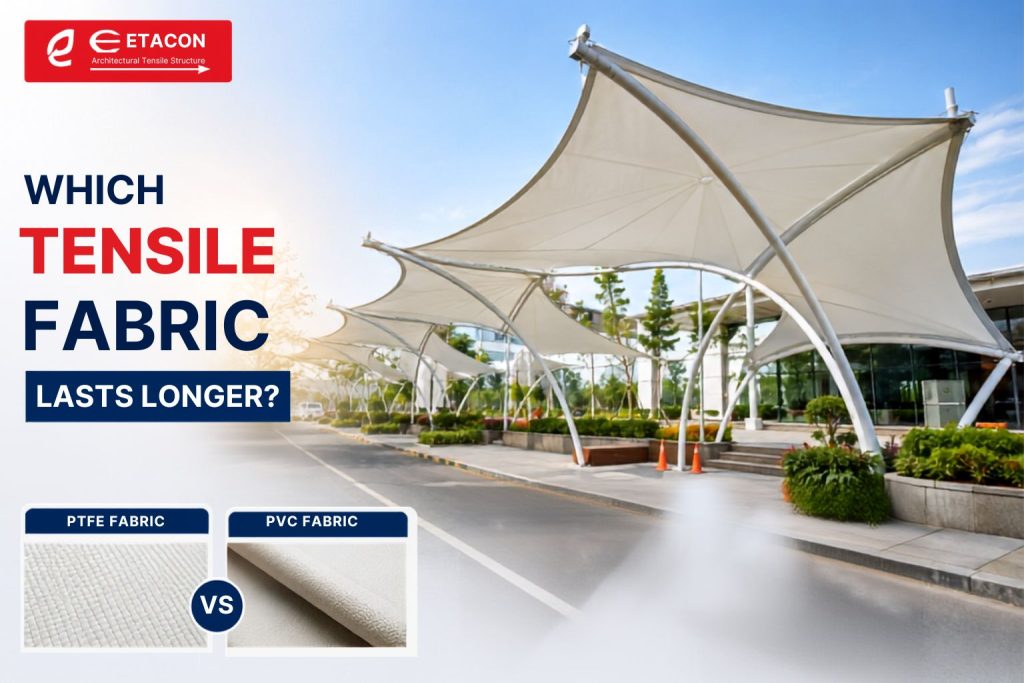
Have you ever stood under a tensile canopy and wondered how long it will actually hold up? For instance, maybe it was at a wedding venue. Or perhaps a stadium. Or even just a bus stop. Either way, it’s a fair question to ask.
Tensile structures look simple. Basically, a stretched skin of fabric sits over a steel or cable frame. However, the fabric itself comes in several types. And as a result, the lifespan differences between them are bigger than most people expect.
So, let’s break down the main options. First, we’ll look at where each one shines. Then, we’ll look at where it falls short.
The Four Main Tensile Fabric Types
Overall, there are really four fabrics that dominate this industry:
- PVC-coated polyester
- PTFE-coated fiberglass
- PVDF-coated polyester
- ETFE foil
Firstly, each one is built differently. Secondly, each one ages differently. And finally, each one is priced differently. Importantly, that last point matters a lot, because “lasts longer” is only half the story. In other words, the real question is usually: lasts longer for the money?
PVC-Coated Polyester: The Budget Workhorse
Generally, this fabric shows up on temporary event structures and smaller canopies. Specifically, it’s a polyester weave, dipped or coated in PVC. Sometimes, it also gets a topcoat, such as acrylic or PVDF, to slow down UV damage.
Realistic lifespan: 7 to 15 years, depending on the topcoat and climate.
Primarily, the main weakness is sun exposure. Over time, plain PVC yellows and fades. Additionally, it gets brittle and chalky, especially in hot, high-UV climates. Similarly, humidity adds another risk, since fungal growth can take hold if the fabric isn’t cleaned often.
Nevertheless, PVC has real advantages too. For example, it’s cheap, easy to fabricate, and easy to repair. Therefore, for structures you don’t need forever, it’s a solid trade-off.
PVDF-Topcoated Polyester: A Step Up From PVC
Essentially, think of this as PVC-coated polyester with sunscreen. In particular, a PVDF (polyvinylidene fluoride) film gets laminated on top of the base coating.
Realistic lifespan: 15 to 20 years.
Because of this extra layer, PVDF resists dirt and UV yellowing far better than raw PVC. As a result, these structures stay whiter for longer, and the material underneath also degrades more slowly.
Admittedly, this option costs more than standard PVC. Still, it costs noticeably less than PTFE. Consequently, it’s become a popular middle-ground choice, and you’ll often see it on retail canopies, transit shelters, and mid-tier stadium roofing.
PTFE-Coated Fiberglass: The Long-Haul Champion
Typically, this is the go-to material for major permanent structures, such as airport terminals, large stadiums, and landmark roofs. Here, the base fiber is glass, coated in PTFE — in fact, the same chemical family as Teflon.
Realistic lifespan: 25 to 35 years, sometimes longer with good upkeep.
Notably, PTFE-coated fiberglass barely degrades from UV exposure. Furthermore, it’s largely self-cleaning, since dirt struggles to stick to the slick surface, and rain does a lot of the maintenance work on its own. On top of that, fire resistance is excellent, which is exactly why it shows up in public buildings with strict codes.
However, there is a catch. Namely, fiberglass doesn’t like folding or creasing, so once the coating cracks at a fold line, that spot becomes a weak point. In addition, this material costs more upfront, and repairs are trickier and pricier. Even so, for a structure meant to last decades, PTFE usually earns its price tag.
ETFE Foil: The Lightweight Long-Termer
Technically, ETFE isn’t a woven fabric at all. Instead, it’s a thin, transparent polymer film, usually used as an inflated cushion — think of the Eden Project domes or the Beijing Water Cube. Because of this, people often compare it to PTFE for long-span roofing.
Realistic lifespan: 25 to 30+ years.
Much like PTFE, ETFE resists UV extremely well. Also, it stays flexible in a way that fiberglass fabrics simply don’t. Similarly, it’s largely self-cleaning thanks to its non-stick surface. Plus, because it’s so lightweight, it reduces the load on the supporting structure.
On the other hand, ETFE needs an air-inflation system to hold its cushion shape. As a result, this adds mechanical complexity, along with an ongoing maintenance dependency that PVC and PTFE systems don’t have.
So, Which Fabric Actually Lasts Longest?
In short, PTFE-coated fiberglass and ETFE foil last the longest, typically reaching 25 to 35 years. That said, PTFE has a slight edge for structural, non-inflated applications, plus a stronger track record on large-scale roofs.
However, “longest” isn’t always “best for you.” Instead, a few factors should guide the decision:
- Budget and intended lifespan. For instance, if you’re planning a 5-to-10-year structure, PVC or PVDF is the smarter spend, since there’s no point paying for 30-year material on a 10-year project.
- Climate. Especially in hot, high-UV regions, PVC degrades much faster. So, in places like the desert Southwest or the Middle East, the gap between PVC and PTFE widens quickly.
- Maintenance commitment. Generally, PTFE and ETFE are mostly self-cleaning, whereas PVC and PVDF need regular washing to hit their expected lifespan. Otherwise, neglect shortens their life more than it shortens PTFE’s.
- Shape complexity. Because sharp folds and tight curves are hard on PTFE fiberglass, simple, tensioned shapes suit it best. Conversely, if your design has lots of creasing, PVC’s flexibility might actually work better structurally, even with a shorter raw lifespan.
The Bottom Line
If you’re building something meant to last a generation, such as a stadium roof, an airport canopy, or a landmark structure, then PTFE-coated fiberglass or ETFE foil will still be doing their job in 30 years.
On the other hand, if you’re working with a shorter timeline, a tighter budget, or a shape that doesn’t suit rigid fiberglass, then PVDF-topcoated polyester offers a strong 15-to-20-year middle ground. Meanwhile, standard PVC remains a perfectly reasonable choice for temporary or short-term structures.
Ultimately, the best fabric isn’t the one with the longest lifespan on paper. Instead, it’s the one whose lifespan actually matches what you’re building for.