
Be honest — when was the last time you thought about fire safety before you had to?
Most of us don’t. It’s one of those things that stays in the back of our minds until something goes wrong. And with tensile structures, that’s a habit worth breaking.
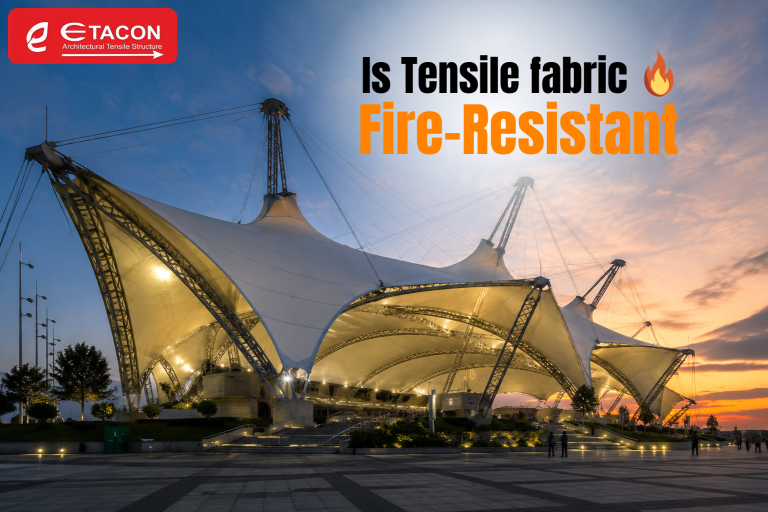
Here’s why. A tensile structure isn’t your everyday roof or wall. It’s a stretch of fabric membrane, pulled taut over a steel or cable frame, doing a job that looks effortless but really isn’t. It’s beautiful. It’s flexible. It lets architects do things a concrete slab never could. But underneath all that design freedom, it’s still a building material. And it still has to hold up when the worst happens.
So let’s actually sit with this topic for a bit — fire-resistant tensile fabrics. What they are, why they matter more than people realise, and how you’d go about picking the right one.
What Does “Fire-Resistant” Actually Mean?
Let’s clear up something first — no fabric on earth is fireproof. None. If anyone tells you otherwise, don’t believe them.
What we’re really talking about is resistance. A fire-resistant fabric is engineered to resist ignition, slow the flames down, and in a lot of cases, put itself out once the heat source is gone. It doesn’t stop fire in its tracks like something out of a movie. It buys you time and limits damage. That’s the honest version.
Most fire-resistant membranes used in tensile structures come down to two materials: PVC-coated polyester or PTFE-coated fiberglass. Nothing random about that choice — both go through some fairly brutal testing to meet standards like NFPA 701, DIN 4102, or EN 13501.
I know, the acronyms get tiring fast. But strip away the jargon and the point is simple — a good fabric behaves predictably under heat instead of turning into a problem of its own.
Why This Actually Matters for Tensile Structures
Think about where you usually see tensile structures.
Stadiums. Airports. Exhibition halls. Shopping centres. Basically, places crammed with people on a regular Tuesday afternoon.
Now imagine something goes wrong in one of those spaces. Every second suddenly matters. A fire-resistant membrane doesn’t make the fire disappear, but it gives people something priceless — time. Time to get out. Time for emergency teams to step in and do their job. A regular, untreated fabric just won’t give you that same window.
There’s a structural angle too, and it’s easy to miss. Tensile structures are lightweight on purpose. That’s the whole appeal — less material, less load, more design freedom than a conventional roof could ever offer. But that same lightness means the covering has to carry more of the safety burden on its own. There’s no thick concrete slab quietly doing the heavy lifting behind it.
Which is really why fire performance can’t be an afterthought in tensile architecture. It has to be part of the conversation from day one, not something bolted on at the end.
The Main Types of Fire-Resistant Membranes
Okay, let’s actually break this down, because it’s not as complicated as it sounds.
- PVC-Coated Polyester This is the workhorse of the industry, and honestly, most tensile structures you’ve walked under probably used this. It’s cost-effective, durable, and comes in fire-retardant grades that tick the boxes on most international standards. If you’re working on canopies, walkways, or a mid-sized architectural project, this is usually where the conversation starts.
- PTFE-Coated Fiberglass If you’re after something built to last decades, this is it. PTFE fabrics bring exceptional fire resistance, strong UV stability, and a lifespan that can easily push past 25 years. Yes, it costs more upfront. But for landmark structures — the kind meant to stand for generations — it tends to pay for itself over time.
- Silicone-Coated Fiberglass This one’s newer to the scene but catching on fast, and for good reason. It’s flexible, holds up well in extreme temperatures, and still delivers strong fire resistance. If your project’s sitting somewhere with a harsh climate, this one’s worth a serious look.
None of these is objectively “the best.” It really comes down to your project — its scale, your budget, the local climate, and how long you actually need the structure to serve its purpose.
So How Do You Actually Know a Fabric Is Fire-Resistant?
Fair question. And please — don’t just take a supplier’s word for it because they said so with confidence.
Ask for certification. Ask for test reports. Standards like NFPA 701 (USA), DIN 4102-B1 (Germany), and EN 13501-1 (Europe) aren’t just bureaucratic hoops — they put fabrics through genuine fire exposure tests and rate exactly how they hold up.
If a supplier gets vague or can’t produce the paperwork, treat that as a warning sign. A genuinely fire-resistant tensile fabric will have documentation behind every single claim. If it doesn’t, walk away.
A Few Myths We Should Probably Bust
While we’re at it, let’s clear up some things people get wrong all the time.
Myth 1: Fire-resistant means fireproof. We covered this already, but it bears repeating because people mix it up constantly. It means the material resists ignition and slows the spread — not that fire can’t touch it at all.
Myth 2: All PVC fabrics are basically the same. Not even close, actually. Fire-retardant grades go through completely different chemical treatment than standard PVC. Never assume — always check the spec sheet before you commit.
Myth 3: Going fire-resistant means giving up on design. This one used to hold some truth, years ago. Not anymore, though. Today’s fire-resistant membranes come in plenty of colours, translucencies, and finishes. You genuinely don’t have to choose between looking good and being safe.
And Don’t Forget Maintenance
Here’s something that catches people off guard — fire resistance isn’t a one-and-done thing. You don’t just install it and walk away.
Dust builds up. Pollution settles in. General wear happens, quietly, over years. All of it can chip away at how well a membrane performs when it actually needs to. Regular cleaning and periodic inspections go a long way in keeping that protective quality intact.
A well-maintained tensile structure isn’t just safer, either. It looks better, lasts longer, and honestly, it saves you from expensive repairs down the road.
Final Thoughts
At the end of the day, picking the right fabric for a tensile structure was never really about looks or staying under budget. It’s about the people who’ll stand under it, gather inside it, and trust it — often without even realising they’re trusting it — to hold up when it matters most.
Fire-resistant tensile fabrics give you that peace of mind, and they do it without asking you to give up on design. Whether you go with PVC, PTFE, or silicone-coated fiberglass, the right material — backed by real certifications, not just promises — can genuinely make all the difference.
So the next time you’re planning a tensile structure, don’t push fire safety to the end of the list. Bring it in at the start, where it belongs.
About Etacon
At Etacon, we design and engineer tensile structures that don’t cut corners on safety, durability, or how they look. From stadiums and canopies to large-scale architectural landmarks, our team works with certified fire-resistant fabrics because we’d rather build something you can trust than something that just photographs well.
Got a project in mind? Let’s talk about bringing it to life — safely, beautifully, and built to actually last.