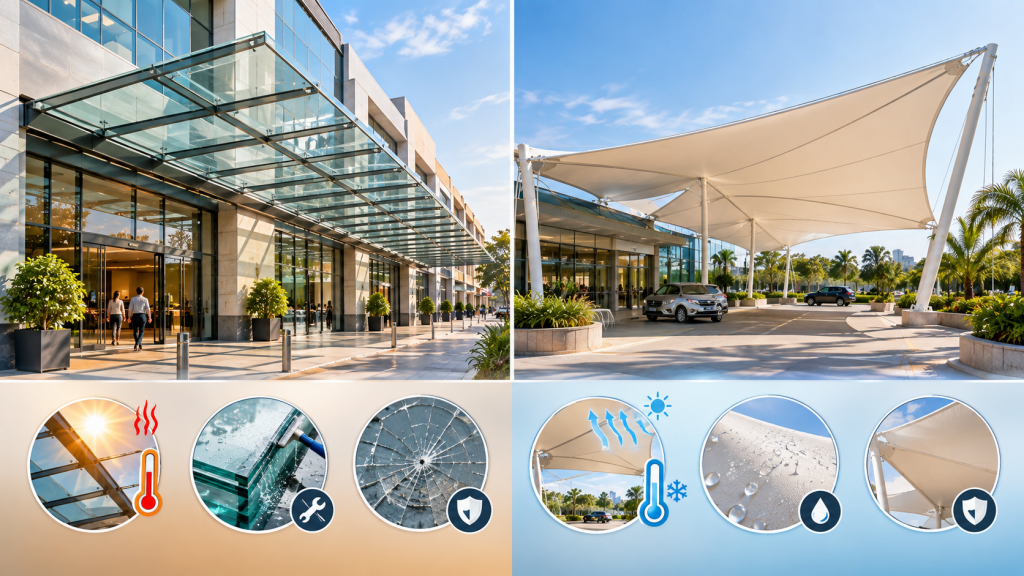
Quick answer: Tensile structures cost significantly less than glass canopies for the same span, roughly a third to half the price in most cases, and they keep spaces noticeably cooler since fabric doesn’t trap heat the way glass does. Glass wins on transparency and a premium architectural look but needs far more cleaning and carries a real breakage risk. For most commercial coverage needs, tensile makes more practical sense; glass earns its place where the design specifically calls for a see-through, high-end finish.
An architect working on a mall entrance once laid both options on the table for her client, glass canopy on one side, tensile fabric on the other, pretty much identical renderings otherwise. The client picked glass purely on looks, until the cost estimate came back. That conversation is worth having honestly, because the two aren’t actually comparable on every front, they’re genuinely different materials solving different problems.
The Heat Difference Is Bigger Than People Expect
Glass transmits heat directly. Even with low-emissivity coatings, a glass canopy lets a meaningful share of solar heat straight through, which is exactly why glass-covered spaces often need extra cooling just to stay usable during peak afternoon hours.
Tensile fabric behaves completely differently. PTFE and PVDF membranes reflect a large portion of solar radiation while still letting diffused light through, so the space underneath stays noticeably cooler without feeling dark. We’ve measured this directly on sites where a client compared an existing glass section against a new tensile extension, the difference in surface temperature underneath often runs several degrees.
Where Each One Costs More
Glass canopies cost more almost across the board, the glass itself, the heavier structural steel needed to support that weight, specialized installation, and the ongoing cleaning that glass demands. A tensile structure’s fabric weighs a fraction of equivalent glass, which means lighter steel, simpler foundations, and a shorter installation timeline too.
For a comparable commercial span, tensile typically runs a third to half the cost of glass, sometimes less depending on the glass specification. That gap widens further once you factor in long-term maintenance, which tilts even more in tensile’s favor.
Maintenance Tells a Different Story Too
Glass needs regular cleaning to stay functional, not just attractive. Dust and grime cut down light transmission fast, and a glass canopy left uncleaned looks worse than almost any other roofing material. Professional cleaning for large glass spans isn’t cheap, and it needs to happen often, especially in polluted urban environments.
Tensile fabric needs cleaning too, but far less frequently, and PVDF-coated fabric in particular shows a genuine self-cleaning effect where rain washes off a good share of accumulated dust on its own. Fabric also doesn’t develop the water spots or mineral staining that glass does over time.
Durability and Risk
Glass carries a breakage risk that fabric simply doesn’t. Hail, falling branches, or structural stress can crack or shatter glass panels, and replacing a cracked panel in a large installation isn’t a quick or cheap fix. Tempered or laminated glass reduces this risk but adds further cost.
Tensile fabric can tear under extreme stress, but it doesn’t shatter, and a tear is almost always a patch repair rather than a full panel replacement. For high-traffic public spaces where safety matters, that difference carries real weight.
Where Glass Still Makes Sense
None of this makes glass the wrong choice everywhere. For architectural statements where transparency genuinely matters, a lobby that wants an uninterrupted view of the sky, a retail frontage designed entirely around visibility, glass delivers something fabric can’t replicate. Premium hospitality and high-end retail projects often choose glass specifically for that visual effect, accepting the higher cost and maintenance as part of the design intent.
Glass also suits smaller, climate-controlled interior spaces better than large exterior spans, where heat gain matters less because the space already has active cooling working against it anyway.
Which One Should You Actually Pick
For parking shades, walkways, large outdoor seating areas, or anywhere heat and cost genuinely matter, tensile fabric almost always makes the more practical choice. For a design-forward entrance, atrium, or any space where visual transparency is the whole point, glass earns its premium.
A fair number of larger commercial projects actually combine both, glass where visibility matters most, tensile fabric covering the larger surrounding spans where cost and heat performance carry more weight. That combination often gives the best of both without paying glass prices across an entire project.
Frequently Asked Questions
Is a tensile structure cheaper than a glass canopy? Yes, typically by a third to half for a comparable span, once you factor in lighter steel requirements, simpler foundations, and lower installation complexity.
Does glass or tensile fabric keep a space cooler? Tensile fabric keeps spaces noticeably cooler, since PTFE and PVDF membranes reflect a large share of solar heat while glass transmits it through more directly.
Which needs more maintenance, glass or tensile fabric? Glass needs more frequent professional cleaning to maintain light transmission and appearance. Tensile fabric, especially PVDF-coated, needs cleaning far less often.
Can a glass canopy break or crack? Yes, glass carries a real breakage risk from hail, debris, or structural stress. Tensile fabric can tear under extreme conditions but doesn’t shatter, and repairs are typically simpler.
Final Thought
Tensile and glass aren’t really competing for the same job most of the time, they solve different priorities. Tensile wins decisively on cost, heat performance, and maintenance for most commercial coverage. Glass wins where transparency and a specific architectural statement matter more than practicality. Knowing which priority actually matters for a given project makes this choice a lot easier than comparing two renderings side by side and picking on looks alone.
Keywords: tensile structure vs glass canopy, glass canopy vs tensile fabric cost, tensile structure heat comparison glass, glass canopy maintenance cost, tensile fabric vs glass roofing, which is better tensile or glass canopy, commercial canopy material comparison, tensile structure cooler than glass.