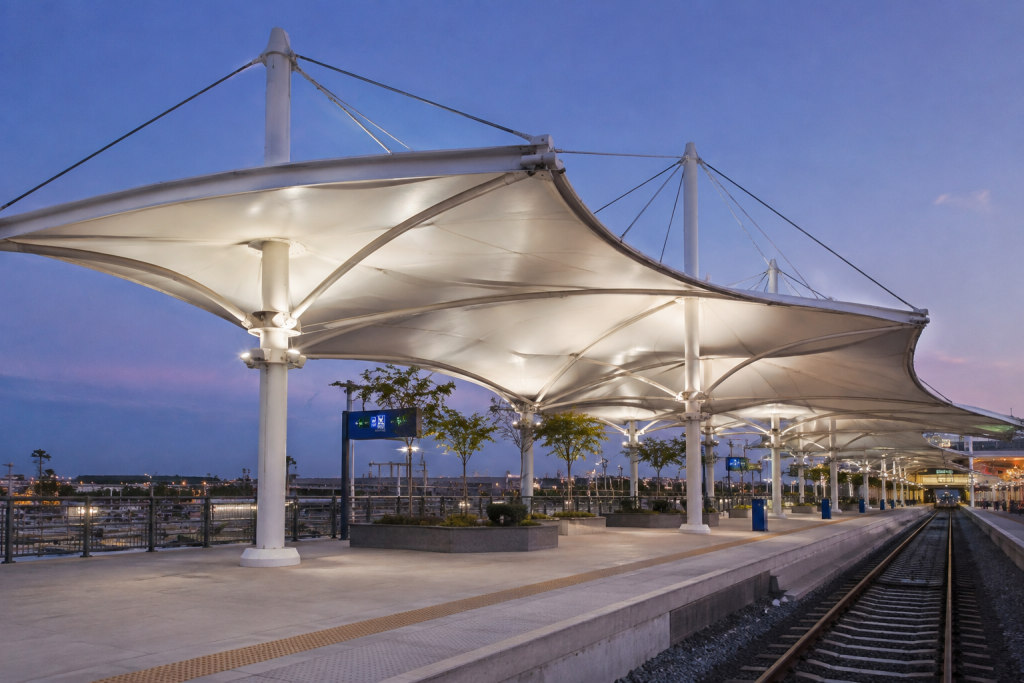
Tensile structures are roofs made from stretched fabric, held up by steel cables and masts. On metro stations and railway platforms they cover wide areas with very few columns, go up quickly, let in daylight, and keep rain and sun off passengers. Most of the time they also cost less than a heavy steel or concrete roof.
Think about the last time you stood on a railway platform at 2 pm in June. The tin shed overhead was probably soaking up heat and handing it right back to you. Or think of a monsoon evening, with water blowing sideways under a roof that only covers half the platform. Nobody notices a good platform roof. Everybody notices a bad one.
That is the main reason tensile roofing keeps showing up in new transit projects. It solves everyday problems in a simple way.
So, what exactly is a tensile structure?
Picture a bedsheet pulled tight between four poles. That is the basic idea. A tensile structure uses a fabric membrane that is stretched and anchored, so the material itself is under tension. Steel cables and masts do the heavy lifting, and the fabric forms the roof surface.
The curved shape is not just for looks. Those curves are what make the roof strong. Water runs off, wind flows over, and the load spreads evenly.
For stations, three fabrics come up most often. PVC-coated polyester is the budget-friendly choice and works well for most platform canopies. PTFE-coated fiberglass costs more but lasts much longer and resists fire and dirt better. ETFE foil is very light and almost clear, so it suits places where you want a lot of sky.
Why do they suit metro stations and railway platforms?
A platform is a strange place to build a roof. It is long and narrow. Trains run right beside it. People crowd in during peak hours. And you rarely get more than a few hours of shutdown to work.
Tensile roofs handle most of this well.
Fewer columns. On a packed platform, every column is something people bump into or hide behind. Tensile systems cover long spans, so you can keep the platform clear. That helps with crowd movement and with evacuation too.
Quick installation. The fabric is cut, welded, and stitched in a workshop. At the site, crews mostly lift, fix, and tension. When you are working next to live tracks, that short on-site time is a huge advantage.
Daylight. A translucent membrane lets soft light through during the day. Stations feel brighter, and you can switch off a good number of lights. Over a year, that saves real money on electricity.
Heat control. Light-colored membranes reflect a large part of the sun’s heat. Standing under one is clearly cooler than standing under a dark metal sheet.
Low weight. The roof is light, so foundations can be lighter too. This matters a lot on elevated metro stations, where every extra kilo on the structure adds cost. It also makes retrofitting an old station far easier.
A look people remember. Let’s be honest, many stations look the same. A well-shaped canopy gives a station its own face, and passengers remember it.
Where do you actually see them used?
Platform shelters are the obvious one. But tensile roofing also works over station entry and exit points, foot overbridges, skywalks, bus-to-metro interchange areas, ticket counters, waiting zones, and the parking and drop-off areas around stations.
What should be checked before you build one?
A tensile roof looks simple, but the engineering behind it is not. A few things need proper attention.
Wind is the big one. Platforms are usually open on the sides, so the roof sees strong uplift and some flutter. This has to be calculated, not guessed.
Fire rating comes next. Transit projects have strict rules, and the fabric you choose must meet them.
If the line is electrified, you also need to think about clearances from overhead wires and the material’s behavior around them.
Drainage is easy to forget until water starts pooling in one corner. The shape should push water to proper outlets.
Then there is climate. A coastal city with salty air, a dusty northern city, and a humid eastern city all treat fabric differently. Pollution matters as well, which is why self-cleaning coatings are popular in dense cities.
Last, think about maintenance access. If nobody can safely reach the roof for cleaning, it will not get cleaned.
How long does a tensile roof last?
It depends on the fabric and on how well it is looked after. PVC membranes usually give you somewhere around 10 to 15 years. PTFE-coated fiberglass can go past 25. Cables, joints, and tension should be checked regularly, and the fabric needs a wash now and then. It is low-maintenance, but not zero-maintenance.
How does it compare with a normal roof?
A conventional steel or concrete roof is heavier, slower to build, and usually needs more columns. It also lets in less natural light. A tensile roof flips most of that. Where it falls short is in very high-impact zones or places with extreme vandalism risk, where the fabric needs extra protection or a higher mounting height. Good design takes care of this, but it is worth knowing.
Frequently asked questions
Is it safe to use a tensile roof on a railway platform?
Yes, as long as it is designed by qualified engineers for the local wind, fire, and structural requirements. These roofs are used in transit projects across the world.
Can it handle heavy rain?
It handles rain well. The tight, curved surface drains water fast. Just make sure the drainage design is done properly.
Will it keep the platform cooler?
Usually, yes. The membrane reflects a lot of solar heat and blocks direct sun, so the space feels cooler than under a dark metal roof.
Is it cheaper than steel roofing?
For large spans, often yes. You save on material weight, foundation work, and installation time.
Can an old station be upgraded with one?
Yes. Since the system is light, it is a popular choice for retrofits.
Final thoughts
A railway platform or metro station is where a city meets its people every single day. The roof over that space decides whether a commute feels tolerable or exhausting.
Tensile structures give planners a practical way to do better. They go up fast, they stay bright and cool, and they leave the platform open for people to move. If you are working on a transit project, they deserve a serious look. Just pick the right fabric, get the engineering done properly, and work with a fabricator who has handled rail projects before. A good canopy does more than keep the rain off. It makes the station feel cared for.
keywords:
tensile structures for railway platforms, tensile membrane roofing for railway stations, metro station canopy design, railway platform shed, PTFE tensile structure for stations, PVC membrane canopy for platforms, tensile fabric structure manufacturer, tensile roofing for transit stations, platform shelter tensile structure, FOB and skywalk tensile cover