
An architect sent us two samples last year, each about the size of a handkerchief. One was a milky white fabric that glowed when she held it to the window. The other was a dense grey sheet that blocked the light completely. “Both are tensile fabric,” she said. “So why does my client keep asking which one is better?”
It’s a fair question, and the honest answer is that neither wins every time. Translucent tensile fabric and opaque fabric do different jobs. Pick the wrong one, and you’ll either pay for lamps all day or squint in glare. So let’s go through where each one makes sense.
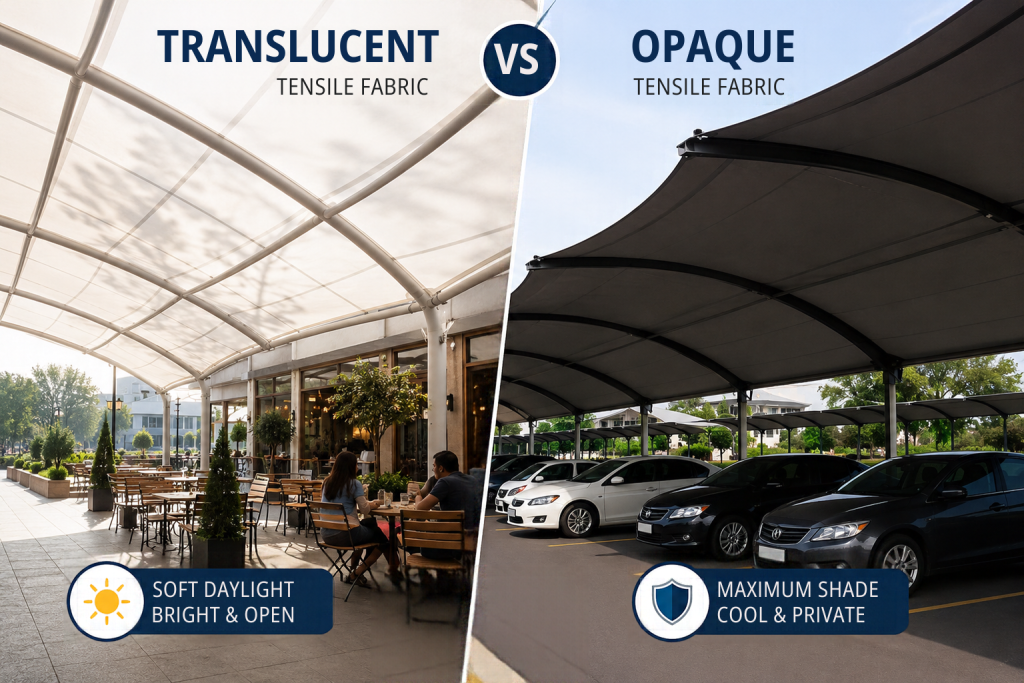
Quick answer: Translucent tensile fabric lets a share of daylight pass through, which creates a soft, bright space and saves daytime lighting. Opaque fabric blocks nearly all light, which gives deeper shade and more privacy. Use translucent for walkways, canopies, and cafes. Use opaque for parking bays, storage areas, and spots that need darkness or heavy shade. Both look good, and both last for years.
What’s the real difference?
It comes down to how much light gets through. That’s it.
Translucent fabric has a lighter coating and a weave that passes some daylight. You can see a soft glow from below, and shadows look faint. Opaque fabric has a denser or darker coating that blocks almost everything. Underneath, it feels like being in a shaded room.
Some people say “translucent” and mean white. That’s not quite right. Colour and light transmission are separate things, and you can get both in different combinations. We talk about colour on its own in another post.
Where does translucent fabric work best?
Anywhere people want to feel they’re still outside.
Walkways are a classic fit. Our tensile walkway structures often use translucent fabric, because it keeps the path bright without lamps in the morning. Cafe patios, hotel entrances, school play areas, and courtyards also suit it. In each case, people want shade, not a cave.
At night, translucent fabric turns into a lantern. Warm LEDs placed under the roof make the whole surface glow. Wedding lawns and restaurants love that effect, and you can’t get it from an opaque roof.
Where does opaque fabric win?
When you need real shade, privacy, or darkness.
Car parking bays are the obvious one. Cars don’t care about glow, and a dense roof protects paint and interiors better from direct sun. Storage yards and loading areas also like opaque fabric, because it keeps stock cooler and out of view.
It works for privacy as well. Swimming pool changing areas, rooftop terraces, and some hospital zones prefer opaque fabric so that nobody can see in or out.
And some sites simply get too much glare. Under strong sun, a translucent roof can feel very bright at certain angles. An opaque roof removes that problem.
What about heat and light costs?
This is where people get tripped up.
Translucent fabric saves on daytime lighting. If you cover a large walkway or hall, that adds up through the year. But it also lets some solar energy through, so a single-layer translucent roof can feel warmer than a dense opaque one. Light colours and open sides help.
Opaque fabric blocks more heat, but you’ll need lights earlier, even on cloudy afternoons. The saving on cooling can cancel the cost of lamps, or it can fall short. It depends on how hot your site gets and how long people stay.
If you want the best of both, a double-layer roof works well. The outer layer takes the sun, and the inner layer softens the light. It costs more, but the comfort is noticeably better.
Does fabric type change the choice?
A little. Most PVC, PVDF, and PTFE fabrics come in both translucent and opaque versions. PTFE tends to be the most translucent, which is why you see it on stadiums and public plazas. PVC suits both uses and costs less. You can see the range on our Our Products page.
How do you choose?
Ask three simple questions.
What do people do under it? If they sit, eat, or walk for long stretches, translucent usually feels better. If they only park or store things, opaque is simpler.
How hot is the site? In very hot areas, think about double-layer or open sides if you choose translucent.
Do you need privacy? If yes, go opaque.
If you can’t decide, ask your fabricator for a sample and hold it up in your own site’s sunlight. Ten seconds of that tells you more than a catalogue.
Frequently Asked Questions
Is translucent tensile fabric waterproof?
Yes. Both translucent and opaque architectural fabrics have waterproof coatings. Light transmission doesn’t change how they shed rain.
Can I mix both on one structure?
Yes. Many designs use translucent panels in the centre for light and opaque panels at the edges for shade.
Final Thought
Picking between translucent and opaque isn’t about which one is better. It’s about what the space needs to feel like. Choose translucent for glow, openness, and low daytime lighting. Choose opaque for deep shade and privacy. When you want both, use a mix or a double-layer roof. If you’d like help deciding, our team can walk you through samples on our Our Services page. For background on how fabric roofs work, this overview of a tensile structure is a good start.
About Etacon
Etacon is a tensile structure manufacturer based in Gurugram, Delhi NCR. The company has been making tensile structures and canopy solutions since 2004, and it works on residential, commercial, industrial, and public projects across India. Etacon designs, fabricates, and installs car parking shades, entrance canopies, walkway covers, gazebos, facades, and custom fabric structures. Explore the full range on the Our Products page, or read about the design and installation process on the Our Services page.
Contact Etacon
Etacon: Architectural Tensile Structure Ground Floor, 606/2A, Sector 37, Pace City I, Sector 10A, Gurugram, Haryana 122001 Phone: +91-9873310328, +91-9818048428, 0124-4266119 Email: sales@etacon.co.in Website: etacon.co.in Managing Director: Mr. Prabhu Patil
Keywords: translucent tensile fabric, opaque tensile fabric, translucent vs opaque fabric, tensile fabric light transmission, translucent fabric canopy, opaque fabric parking shade, tensile roof daylight, double layer tensile roof, architectural fabric India, tensile structure Gurugram